

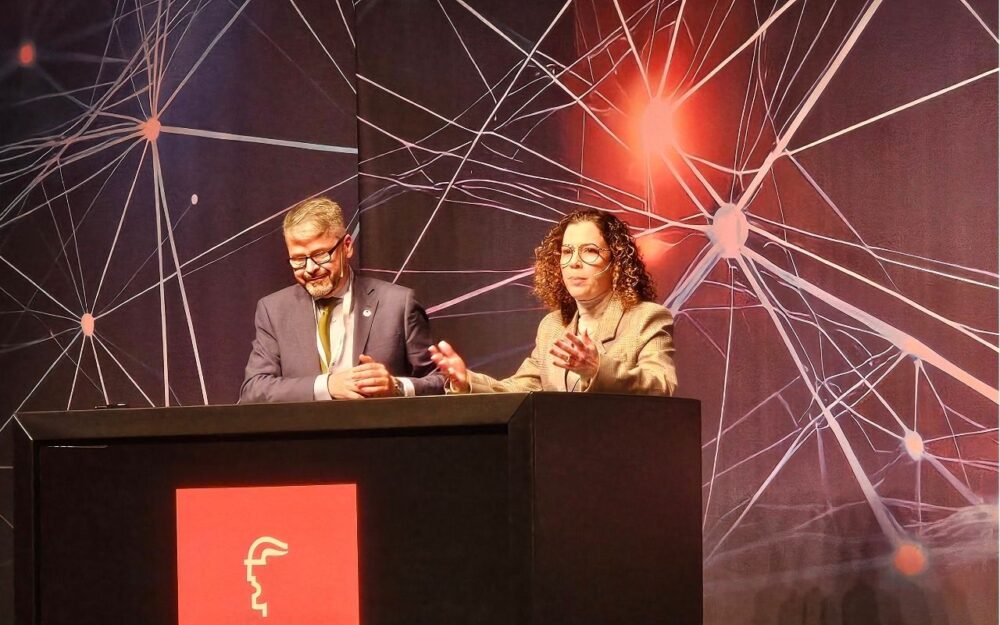

Brazil’s message at the Hannover Messe Press Preview last week was unambiguous. The country is far more than the agricultural giant the world tends to see. As the 2026 Partner Country to the fair, Brazil is using the world’s leading industrial trade fair to reintroduce itself. Two months before Hannover Messe opens its doors, we met with the Brazilian Trade and Investment Promotion Agency (APEX Brazil) team to find out what competitive advantages the country brings to the table beyond agribusiness.
When most people think of Brazil, Carnival, coffee, soybeans, and rainforests come to mind. But at Hannover Messe 2026, the world’s leading industrial trade fair, Brazil is arriving with a very different message. As this year’s official Partner Country, South America’s largest economy is seizing one of its biggest stages yet to reintroduce itself to the world. Brazil will showcase its strenghts not just as an agricultural powerhouse, but as a serious player in advanced manufacturing, green energy, digital technology, and sustainable industry.
A Whole Ecosystem
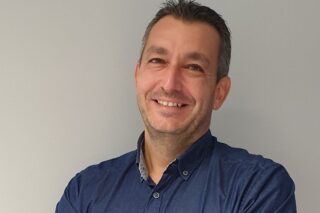
For Alex Figueiredo, Head of Office at APEX Brazil Europe,
“I know that many people associate Brazil primarily with agribusiness. Indeed we are a powerhouse in that sector… but we are much more than that.”
Two years of preparation with Deutsche Messe have gone into crafting a delegation that tells a new story. The story of a country that designs and manufactures airplanes, cars, trucks, and machinery. That produces world-class software. That leads in biofuels while feeding the world. That holds the raw materials Europe needs for its green transition, and has the industrial capacity to process them.
“Our idea is to show Brazil as a whole ecosystem,” says Marcia Nejaim, in charge of APEX Brazil Southeast Region in an interview with DirectIndustry. “Not only agribusiness, not only cultural things — but as a group of solutions to tackle the problems of today.”
And for that, the country is bringing its most ambitious delegation to date. 140 exhibitors, 59 startups, and a total of approximately 300 companies spread across nearly 2,700 square meters across 6 halls. President Lula himself is attending, a signal of just how much Brazil is investing in this moment.
A Green Industrial Base — By Design
One of Brazil’s strongest cards at Hannover Messe is one that European manufacturers are increasingly desperate for: genuinely clean energy. Around 85% of Brazil’s electricity comes from renewable sources (hydropower, wind, solar, and biomass). This gives the country one of the cleanest electricity mixes among major global economies.
“Solutions made in Brazil, or machines made in Brazil, start with a low carbon footprint,” explains Alex Figueiredo. “This is something we have because our energy is green.”
That advantage extends across the supply chain. Brazil is the world’s second-largest holder of critical minerals and rare earth materials — the building blocks of batteries, electric motors, semiconductors, and the green technologies Europe urgently needs.
“We have the entire supply chain in Brazil,” says Figueiredo. “We can deliver without supply chain disruption — and it’s green.”
On biofuels, Brazil has a track record that pre-dates the current energy transition debate by decades. The country pioneered flex-fuel technology (Volkswagen produced the world’s first flex-fuel car there). And it is now scaling up sustainable aviation fuel and next-generation biofuels.
Crucially, as Figueiredo points out,
“this has been achieved without competing with the food industry”.
That means the technology already starts from a low carbon baseline.
More Than Fields: Brazil’s Industrial Depth
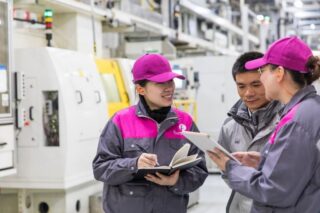
The delegation at Hannover Messe is carefully curated to challenge the agribusiness stereotype, mixing large national champions with SMEs and startups. Among the flagship companies that will be on the ground:
Embraer, one of the world’s leading aircraft manufacturers. They will be showcasing urban air mobility solutions through their new EV Air Mobility subsidiary. Their technology aims to redefine transportation in smart cities.
WEG, one of the globe’s largest manufacturers of electrical machines, operating across 140 countries.
Vale, a mining giant, will be presenting its latest technologies in critical materials.
And BE8, a biodiesel leader offering decarbonization solutions for logistics.
Brazil is also the most dynamic startup ecosystem in Latin America, responsible for 50% of the region’s venture capital activity. The delegation includes 59 startups, one of which was the first to be accelerated by Nvidia.
At a macro level, Brazil has recently launched a national industry program built around 6 pillars: sustainable industrial chains, health, infrastructure, digital transformation, decarbonization, and defense. A new National Energy Transition Policy is driving the shift toward a low-carbon economy, while a dedicated legal framework for green hydrogen is positioning Brazil to become a major producer and exporter of low-carbon hydrogen.
“Brazil is a stable democracy, a strong emerging economy, and a key producer of renewable energy and strategic minerals,” says Ambassador H.E. Rodrigo Baena Soares during a press conference. “The time to act together to make the most of our complementarities is now.”
The Mercosur Factor
Timing matters here. The recently concluded EU-Mercosur trade agreement — one of the largest trade deals in history — adds significant weight to Brazil’s pitch. For European companies, it opens a market of over 270 million consumers with reduced tariffs and simplified customs procedures. And for Brazilian manufacturers, it creates new access to European markets and investment flows.
“The provisional application of the Mercosur agreement could be a major step forward in our path towards diversification and resilience,” says Ambassador Baena Soares, “especially in times of growing protectionism and unpredictability.”
For logistics operators, sourcing managers, and industrial decision-makers, the combination of the trade agreement, Brazil’s green energy credentials, and its critical mineral reserves is beginning to shift the conversation.
What Brazil Wants from Europe
Brazil holds a symbolic place in Hannover Messe’s history: it was the very first Partner Country when the format was introduced by Deutsche Messe in the 1980s. Returning in 2026 in that same role, Brazil is actively seeking long-term technology partnerships.
“In terms of green hydrogen, we are keen to build long-term partnerships,” says Figueiredo. “In AI and quantum technology, we know Germany is very strong, and we have companies that can cooperate.”
Brazil has also launched a national AI strategy, with ambitious goals to become a world leader in the efficient use of artificial intelligence — with a specific focus on high-capacity computing infrastructure, advanced language models in Portuguese, and business innovation.
“We are bringing companies that are not just looking for customers,” explains Marcia. “We are also bringing companies that want to sell investment opportunities — in data centers, hydrogen, and strategic sectors related to decarbonization and energy transition.”
For Figueiredo.
“Brazil is ready. Ready to collaborate, to invest, to innovate together.”
Hannover Messe 2026 takes place from April 20th to April 24th, 2026. in Hanover, Germany. Brazil participates as the Official Partner Country.
DirectIndustry is a partner of the fair this year again. And as part of this collaboration, we are offering you, our valuable readers, free tickets to attend the show. Get your ticket now!