



Since 2023, building authority and trust (E-E-A-T) has become vital to indexation on Google whether on conventional or AI assisted search. But being indexed doesn’t mean being seen, and even less so being visited. Indeed, Google is no longer content to automatically crown the most authoritative brands — it also seeks to challenge them. That’s where Information Gain comes in: an algorithmic mechanism patented in 2022, that since 2024 is actively promoting content offering a different perspective to the consensus. In this article, VirtualExpo marketing specialist Dante Swift exposes how Information Gain represents both a historic opportunty for challengers in B2B and a warning for established leaders: inherited authority is a depreciating asset – playing it safe is now the riskiest strategy of all.
Key Takeaways:
- Search results are not universal anymore. Since 2024, two people in the same room with different browsing histories can see different page-one results for the same query.
- Google now filters in 3 stages: Relevance (since 1998), then EEAT as a global trust filter, then Information Gain as a personal reranking layer — and most publishers only know about the first two.
- The purple link is being suppressed algorithmically. The userHistory signal suppresses pages you have already read before they appear in your results.
- Challenger brands can break through — but only with original data and a genuinely new angle. Playing it safe is now the riskiest strategy you can have.
- EEAT must become the new anchor of truth in a world where personalisation dissolves the shared epistemic commons.
The Silent Rerank – how Google “hides” your purple links
Have you noticed that Google’s results change when you re-run the same search? Have you ever had the maddening experience of not being able to find a site you remember seeing on page one without visiting when you had the chance? And, have you noticed that even the trusty purple links indicating previously visited sites are slowly disappearing from view?
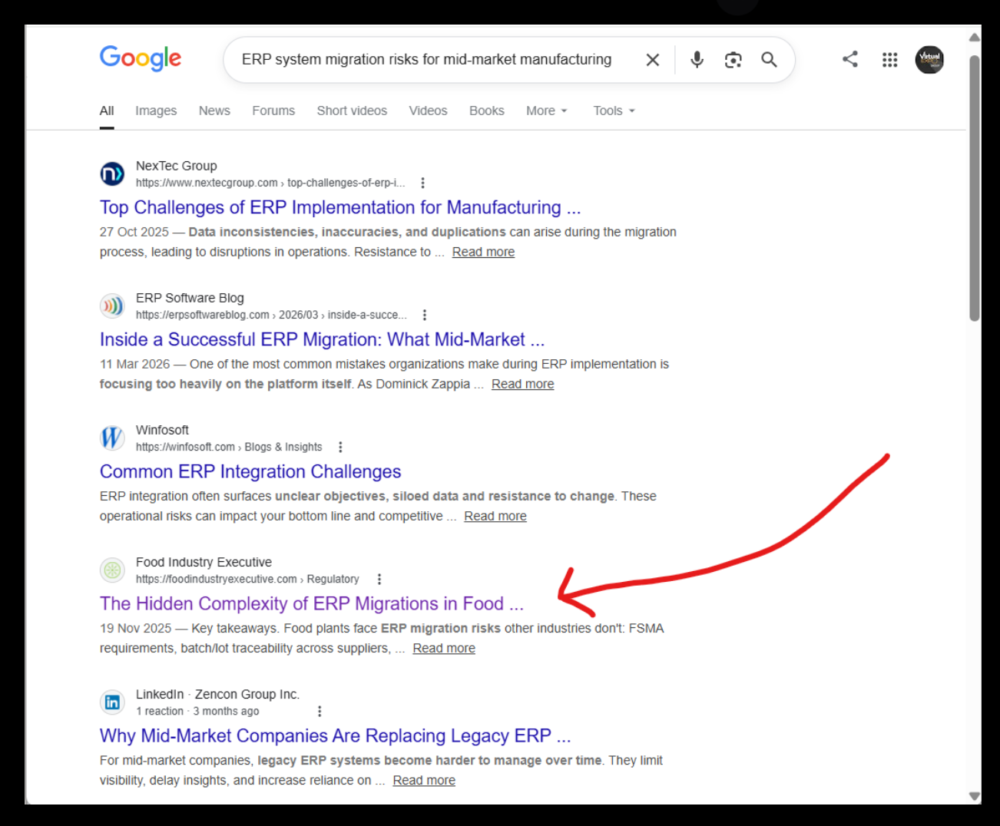
No, you’re not going insane. I thought I was. Here are screengrabs of the top half of Google page 1 for the same search run at 3-minute intervals. (For simplicity I hid the AI overviews and sponsored links.)
➡️ 10:am : the purple link for Food Industry Executive that I visited earlier is still visible:
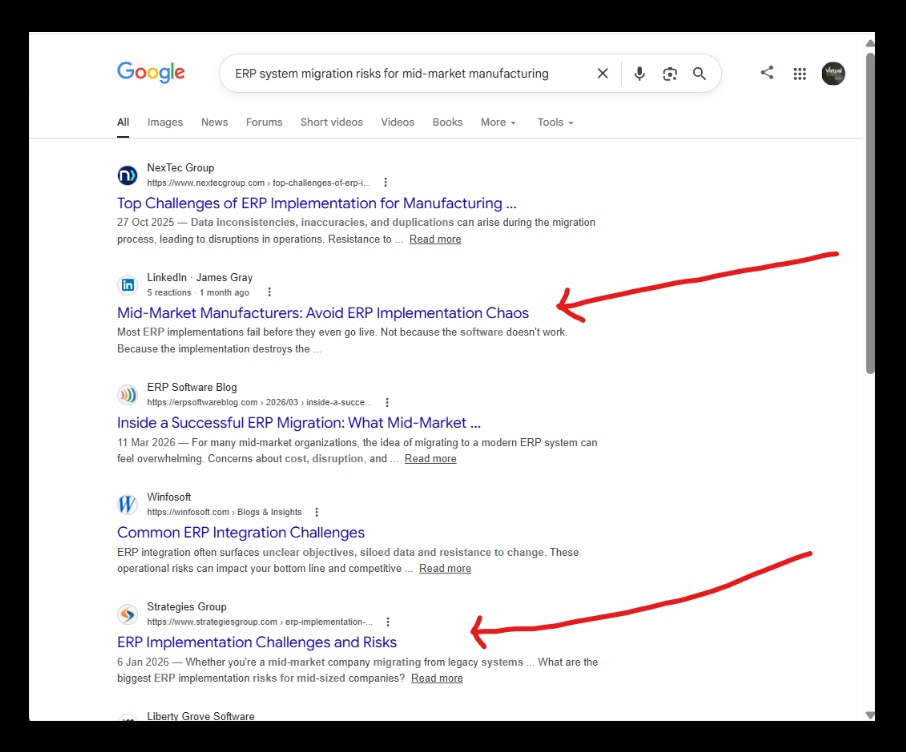
➡️ 10:03 am : Food Industry Executive’s purple link has been replaced by a new blue link from Strategies Group and Zencon Group’s LinkedIn article has been replaced by an article on LinkedIn by a certain James Gray:
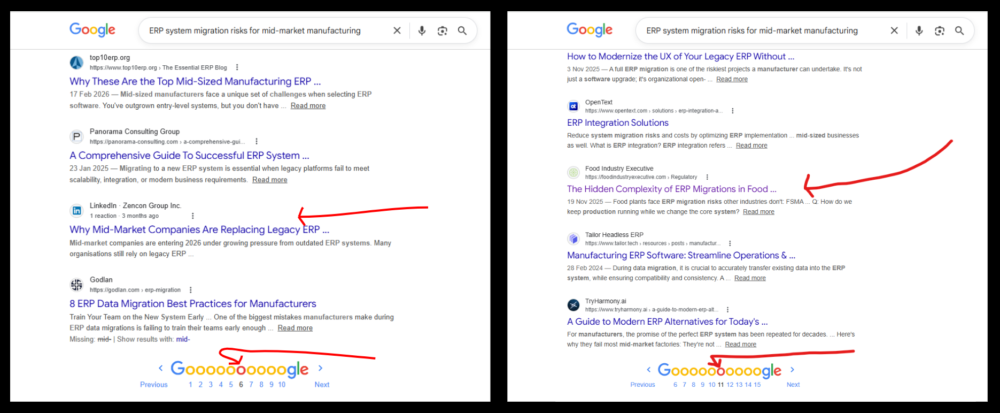
➡️ 10:03am : I found Zencon’s article on page 7 and Food Industry Executive on page 11!
➡️ The bottom of page 1 was pretty wild too (the arrows indicate the new unique links):
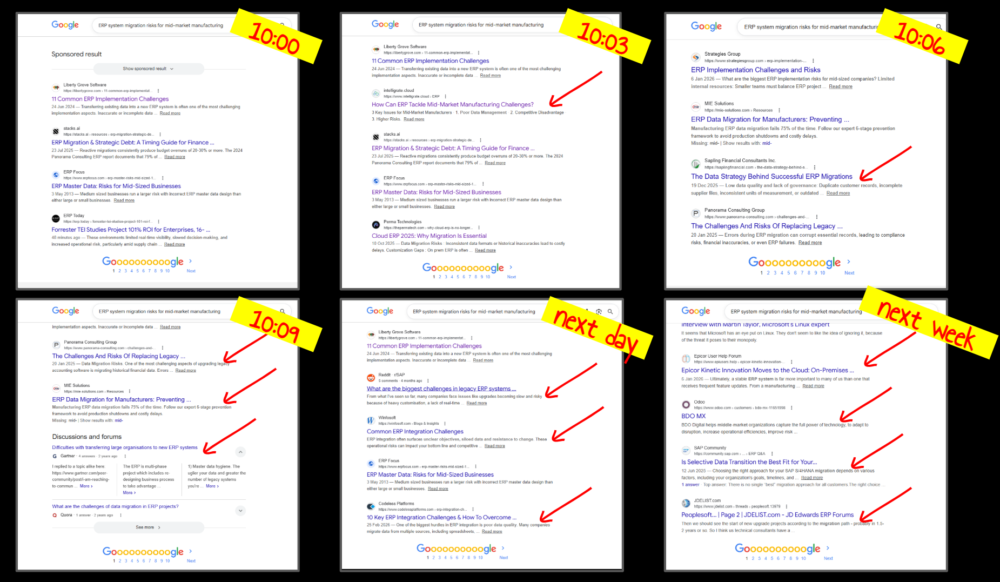
This never really happened before 2024 – certainly not to this extent – so what’s going on?
2022–2024: The AI “Info Glut”
When AI entered the mainstream in late 2022 the web was flooded with sterile content. Myriad FAQs, endless “How to…” guides and formulaic articles with titles like “The 10 Things You Must Know About “….. When you (tried to) read these pages they followed the same pattern: an endless series of subheadings with a paragraph or two of glib text punctuated by clichéd stock photos of diversity-handshaking corporate types in steel and glass open spaces. It’s called “structured content” – bite-size info-chunks that LLMs can easily digest, process and regurgitate anonymously in replies to questions. Content for – and often by – AI rather than humans. In other words, everything that Google despises. Their response wasn’t just an algorithm update – It was a patent: Information Gain.
What Is Information Gain?
Information Gain Patent US11354342B2, filed in 2018 and granted in June 2022, describes a method for calculating how much new information a given page provides to a specific user relative to everything they have already read. It is the engine behind the personalised reranking that most publishers have never heard of.
When AI moved into the mainstream after 2022, Google radically changed the way they ranked websites. From 1998-2023, Google essentially had only one filter: relevance. By 2023, two new and crucial filters had been added:
- Information Gain (since 2024) — Does the page contribute a new perspective — new to you specifically?
- Trust / EEAT (since 2023) — Is the creator recognised as qualified to speak on this subject?
How Information Gain Works?
The filter analogy works up to a point: Google draws from the EEAT well of trustworthiness before applying Information Gain. But rather than simply “handing off,” EEAT continues to engage with it. Google prioritises the highest-authority sites — but when the first few blue links are all broadly saying the same thing, it will re-rank an outlier that challenges that consensus, bouncing it up from page 2 or 3 onto the top half of page 1.
Trust is not binary — there’s often an incremental trade-off with newness — but that outlier site still got through past the initial EEAT filter. Information Gain works both to counterbalance EEAT and to reinforce it. It’s a healthy push-pull.

Information Gain: Counterbalancing EEAT
With Information Gain, Google has built into its algorithm the possibility for challenger brands to break through and change the existing paradigm. This is precisely what Onsemi did in 2022–2025 when it changed the narrative for semiconductors from commodity low-margin products to one of supply chain risk management linked to rare earth minerals and geopolitical instability. By reframing the narrative, they now punch well above their weight on Google and Gemini, appearing alongside behemoths like Infineon and Sony for high-intent supply chain and sustainability keywords.
In the current era, authority is a depreciating asset. If you don’t constantly “refill” your authority with the Information Gain — new technology, data or perspectives — Google’s latest algorithms will eventually treat your site as “cruising on empty.” Legacy brands can no longer cruise eternally on their inherited authority.
Information Gain: Reinforcing EEAT
One of the key tenets of EEAT is the primacy of original experience. If you provide SEO optimisation software, does it run on original data that you yourself have collected — or are you renting it from an anonymous source? If you review consumer electronics, is it after testing them yourself rather than recycling other people’s articles?
In the former case, Information Gain will reward you for contributing new data to the global pool that did not previously exist. This explains in large part the success of Ahrefs, which grew from a small challenger in the SEO intelligence market to the second-largest force behind Semrush, completely overtaking Moz. Ahrefs also pivoted away from generic “How to…” seo guides to focus on controversial opinion pieces, all backed with original data — cementing both its Information Gain and EEAT signals.
EEAT: Reinforcing Information Gain
So Why Are the Purple Links Disappearing?
The purple links aren’t actually disappearing into thin air and they’re still turning purple – but they are increasingly disappearing from page 1 (which for most is tantamount to disappearing). Trying to find out why led me to discover that Information Gain was not a globally applied filter like EEAT – this was personal!
The purple link was a form of user agency: a map of where you had been, visible and under your control. Its algorithmic suppression transfers that navigational memory to Google — quietly, without announcement, and without an opt-out.
Since the advent of mainstream AI, Google has been shifting — from research library to research assistant. Before, Google was the same for every user (geographical differences aside). Since roughly late 2024, two people in the same room with different search histories could see different results for the same search. The general library still stocks the same EEAT-compliant books — but Google is now your personal librarian, finding you a different book on the same subject that you haven’t already consumed. That’s why the purple links are disappearing: why reread the same book? See it as a kind of “redundancy filter”.
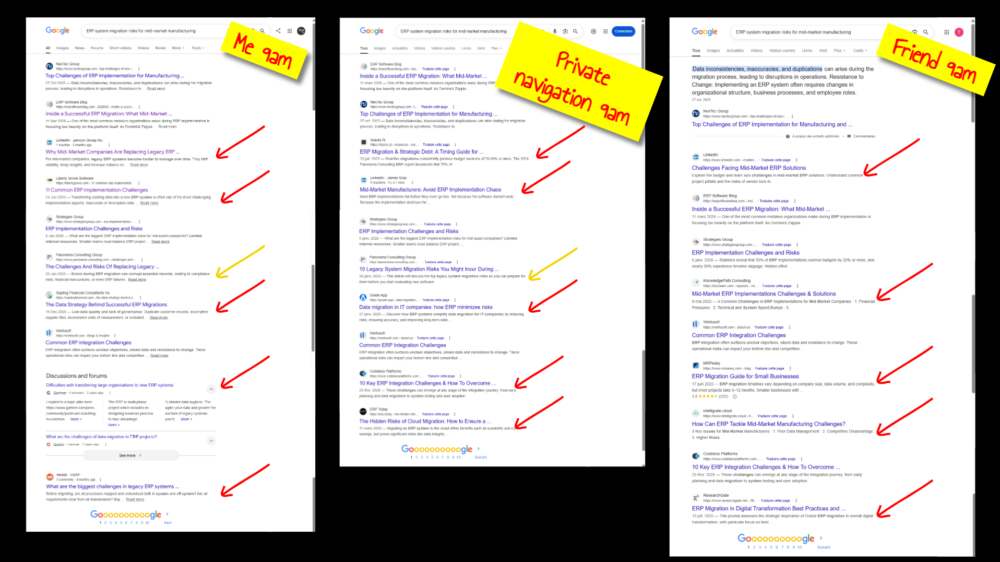
The general library still stocks the same EEAT-compliant books — but Google is now your personal librarian, finding you a different book on the same subject that you haven’t already consumed. That’s why the purple links are disappearing: why reread the same book? See it as a kind of “redundancy filter”. This explains why my friend who knows even less than I do about ERP didn’t get the same results as I did for the same search, done on the same day, in the same town on the same browser (red arrows indicate new websites; yellow arrows indicate different pages from the same website):
Authority still counts
It’s not cut and dried. The highest-authority links will still appear at the top even when they turn purple — pinned there regardless of how many times you’ve visited them. Lower-authority links, however trustworthy, get rotated out in favour of fresh blue links that score higher on your personal Information Gain delta. They do reappear — in my experience every 4th or 5th time you run the same search — which suggests Google applies some minimum authority threshold below which it won’t suppress a result indefinitely, however consumed it may be. Exactly where that threshold sits is not something Google has disclosed.
You can see this clearly in the screengrabs. The ERP Software Blog was in the top 3 in all of them. After visiting the site for five minutes I ran the same search an additional 30 times over the course of a week. Despite changing from a blue to purple, it remained pinned at the top without exception whilst the links below changed and rearranged every time. Here’re it is today, still there at the top:
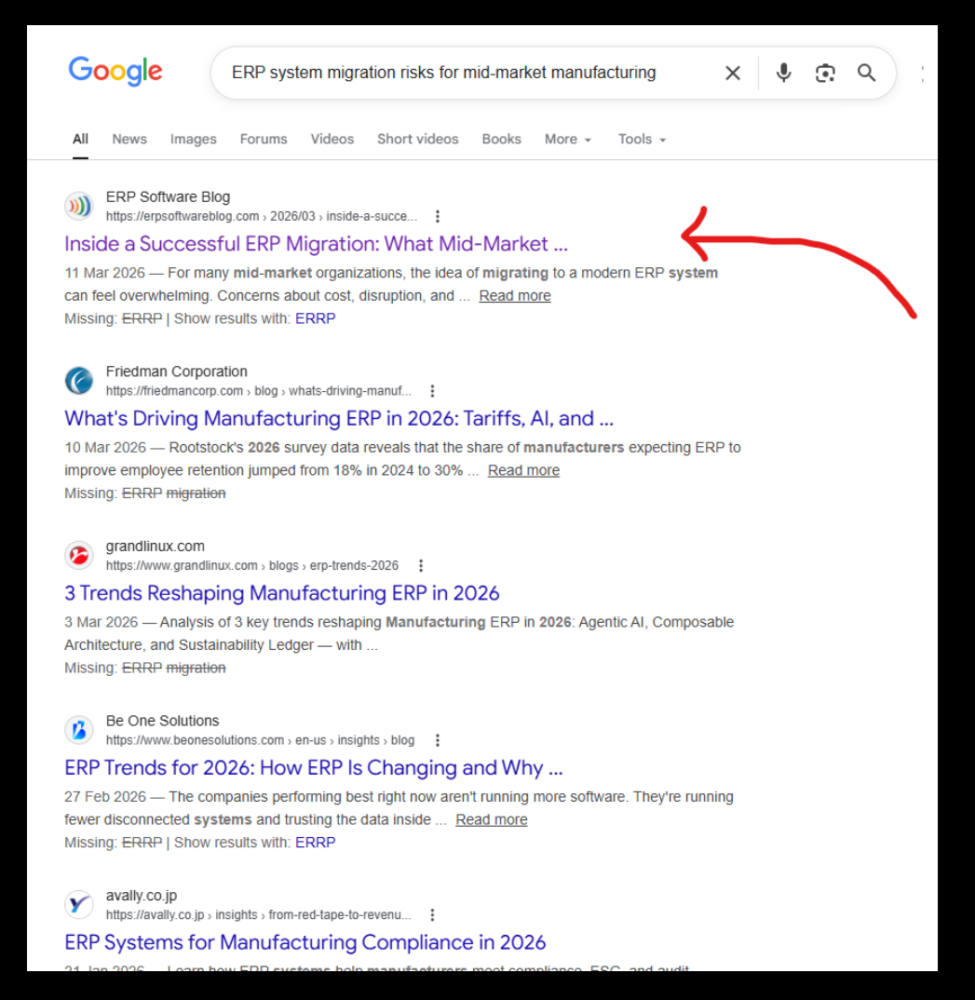
The expIanation – after a little research it became evident that the ERP Software Blog site is something of a bible for ERP — the highest-authority and most consensus-based source in the category — so Google has effectively pinned it to the top as a “truth anchor” and let the shifting sands of Information Gain play out below.
Is Personalised Search a Good Thing?
Google has been incredibly hush-hush about the personalisation of its search results because the answer to this question is so nuanced. The fact that two people in the same room running the same search could see — at least partially — different results is, on paper, highly controversial. You can easily imagine the calamitous headlines decrying “Google embraces post-truth world,” whilst riding roughshod over two fundamental provisos:
- Truth First
Google has studiously developed and reinforced E-E-A-T in tandem with Information Gain in order to ensure the pages curated by the “library” meet a minimum threshold of trustworthiness. In short, Information Gain is subordinated to trustworthiness. If you want to stress-test the system, cast a critical eye at E-E-A-T — not Information Gain.
- Anti-Bubble
For Google, the objective of web search is not the same as the “clickbait and retention” echo chamber of social media. (Google’s AI Overviews have led to a dramatic decrease in clicks). The objective of search is utilitarian — learn in depth about a subject, find the most effective solution to a problem, and so on. As a result, Information Gain is triggered to complement the information you have already consumed — not parrot it. The paradox is therefore that the personalised aspect of Information Gain is precisely what enables it to be anti-bubble.
So is personalised search a good thing? Mostly yes. A librarian who remembers what you’ve already read and recommends something new, something that challenges or extends your understanding, is providing a genuinely valuable service. That’s anti-stagnation. That’s how knowledge actually advances.
The purple link irony is real — basing search on your history means you lose track of your history — and there’s a legitimate question about whether re-reading a valuable page might sometimes be worth more than reading a new one. But once you accept the value of a research tool that promotes Information Gain, personalising it is simply the logical extension of that philosophy. Were Information Gain to remain global, it would deliver only one shot of novelty before calcifying into a new consensus — just a faster-rotating version of the same problem. Personalisation is what keeps the door continuously open to competing and legitimate voices, ensuring that the outlier which has already reached one reader can still reach another.
The Onus is on EEAT
Therefore, the real question isn’t whether personalisation is good or bad. It’s whether the library is well-curated enough to deserve the librarian’s trust. Information Gain is only as reliable as the EEAT filter beneath it. If Google has correctly identified genuine expertise, original observation, and verified authority — then your personal librarian is drawing from a reliable shelf, and the system works as intended.
If it hasn’t — if zero experience content is being passed of as passing the true source, if authority-renting persists in corners of the index, if EEAT trust signals are being gamed — then Information Gain becomes a mechanism for serving users a personalised selection of mediocrity and potentially dangerous content they simply haven’t encountered yet – and shouldn’t. Fresh, tailored, and highly unreliable.
EEAT therefore has to become the new anchor of truth. Not because personalisation is dangerous in principle, but because the librarian’s value depends entirely on the quality of the books in the library. Google has built an elegant system. The question is whether it maintains the collection rigorously enough to ensure any information that is gained is worth gaining.
For content creators and marketers — “playing it safe” is now the riskiest strategy you can have.
The Two-Filter Ranking Architecture: Key Signals
The following table maps some of the key signals indicated by the 2024 Content API Warehouse leak. Though debated to this day — and if true, which would also explain why Google has no interest in publicising Information Gain (it doesn’t want it gamed) — this leak confirmed the shift to personalised search based on user history.
EEAT filter signals are all Global — applied identically to all users before any personalisation begins. Information Gain signals are Personal — using individual session data and browsing history to re-rank sites based on their newness to that specific user.
| Filter: EEAT or InfoGain? | Algorithmic element | Function |
|---|---|---|
| E-E-A-T Global |
siteAuthority | The “legacy” power of a domain based on its link profile and age. Acts as a foundational trust multiplier for established brands. |
| E-E-A-T Global |
isAuthor | Verification of individual credentials and expertise. Maps the byline to a known entity in Google’s Knowledge Graph. |
| E-E-A-T Global |
siteFocusScore | Site-level: Scores the topical concentration of a domain’s entire content portfolio. Penalises generalist sprawl — a finance site with a food vertical, for example. |
| E-E-A-T Global |
siteRadius | Page-level: Measures how far a specific page strays from the site’s established topical centre of gravity. Distinct from siteFocusScore. Acts as a per-page penalty layered on top of the site-level signal. |
| E-E-A-T Global |
contentEffort | AI-driven assessment of the labour and originality in a page. Detects original research, primary data, and first-hand observation versus thin AI rewrites or recycled consensus. |
| E-E-A-T Global |
OriginalContentScore | Detection of unique data points or firsthand experience not already present in the indexed consensus. Rewards the anomaly, the case study, the practitioner’s finding. |
| E-E-A-T Global |
chromeInTotal | Total volume of direct Chrome traffic a site receives, independent of search. Identifies genuine real-world destinations rather than SEO constructs. Feeds into siteAuthority. |
| Info Gain Personal |
GoodClicks / LongClicks | Measures whether a user stayed on a page (Good) or bounced immediately (Bad). |
| Info Gain Personal |
userHistory / previously_viewed_docs |
The core of patent US11354342B2. Tracks the exact URLs a user has clicked to build a personal “consumed set” against which the Information Gain delta is calculated.
★ Purple Link Killer: suppresses results already in the user’s consumed set before they appear in results — removing the visible trail of where the user has already been.
|
| Info Gain Personal |
uniqueChromeViews | Tracks distinct individual human visits to a page (as opposed to aggregate or bot traffic). Validates that real users find a page valuable. |
| Info Gain Personal |
InformationGainScore |
The mathematical delta between the information in a candidate page and the information already in the user’s consumed set. A high delta surfaces pages with genuinely new vectors.
★ AI Overview trigger: when gain is persistently low across a query class, Google may substitute blue links with an AI-generated summary, absorbing traffic rather than routing it to source pages.
|
| Info Gain Personal |
LastClick | The final page a user visited before ending their search session. Interpreted as the result that fully satisfied the user’s intent — the highest possible Gain signal. |
- Patent US11354342B2 — Contextual estimation of link information gain (granted June 2022)
- SparkToro — Google Content API Warehouse Leak Analysis (May 2024)
- Google — How Search Works: Ranking Results
- Google Search Central — SEO developer’s guide
- Powering the Future: onsemi Navigates a Pivotal Shift in the EV and Industrial Semiconductor Landscape
- A buzzword for many, a commitment for onsemi
- Future-Proofing Your Silicon Carbide Design — A Guide for Automotive Manufacturers
- How Ahrefs Grew to $40m+ ARR by Ditching Conventional Marketing Wisdom with Tim Soulo
- Rtings