

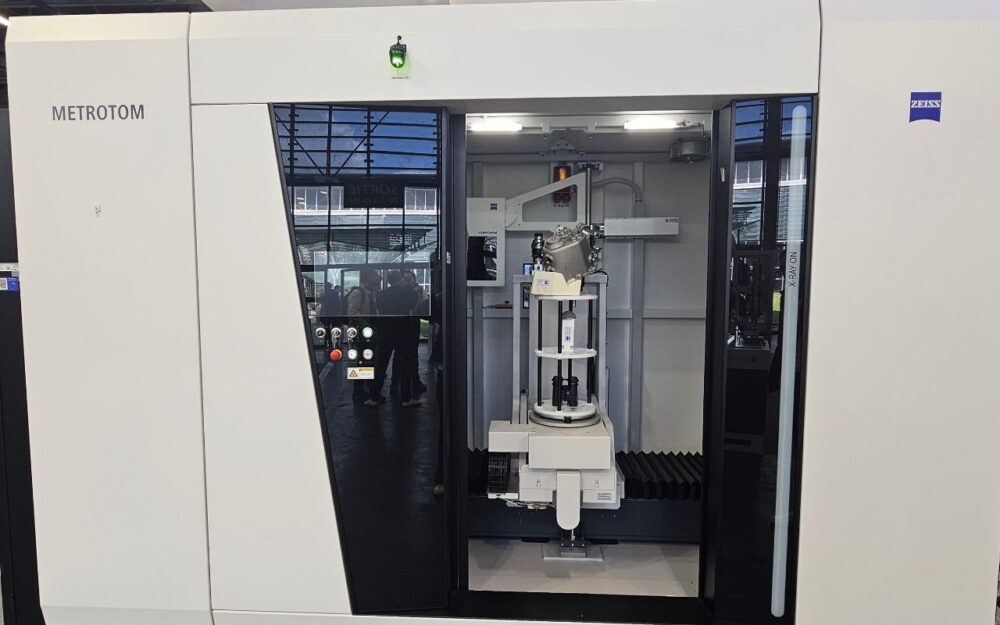

Zeiss presented its METROTOM 1500 for the first time at Global Industrie in France. This X-ray tomograph is designed for the analysis and measurement of large parts. A first for this French exhibition, marking the group’s ambition to push non-destructive inspection further in increasingly demanding industrial sectors.
Seeing Inside Parts Without Destroying Them
The METROTOM 1500 is based on a well-known imaging principle: X-ray tomography. The objective is to observe the inside of a part in three dimensions without having to cut it open.
“We can check for porosities, detect inclusions, or measure wall thicknesses in areas that are otherwise completely inaccessible,” explains Thomas Beuvier, technical expert at Zeiss.
Unlike traditional destructive methods, this technology makes it possible to control manufacturing quality without altering the part, access complex internal areas, and carry out full 3D metrology. This capability has become critical as industrial parts grow increasingly complex.
A Tomograph Designed for Large Dimensions
The particularity of this tomograph is its large size, explains Thomas Beuvier,
“It is one of the largest tomography systems in the Zeiss range. It can accommodate parts around 800 millimeters in height and up to 50 kg on a platform. The larger the cabin, the larger the parts that can be processed. This is exactly what industry needs today.”
This positioning directly responds to a market evolution: the increase in the size of industrial components, notably in automotive (gearboxes, batteries), aerospace, energy, and medical sectors. The Metrotom 1500 addresses a wide range of industries.
“In automotive, batteries are a key point. There are many tests and measurements that can be carried out on batteries for electric vehicles to ensure everything works properly throughout their lifecycle, including safety checks.”
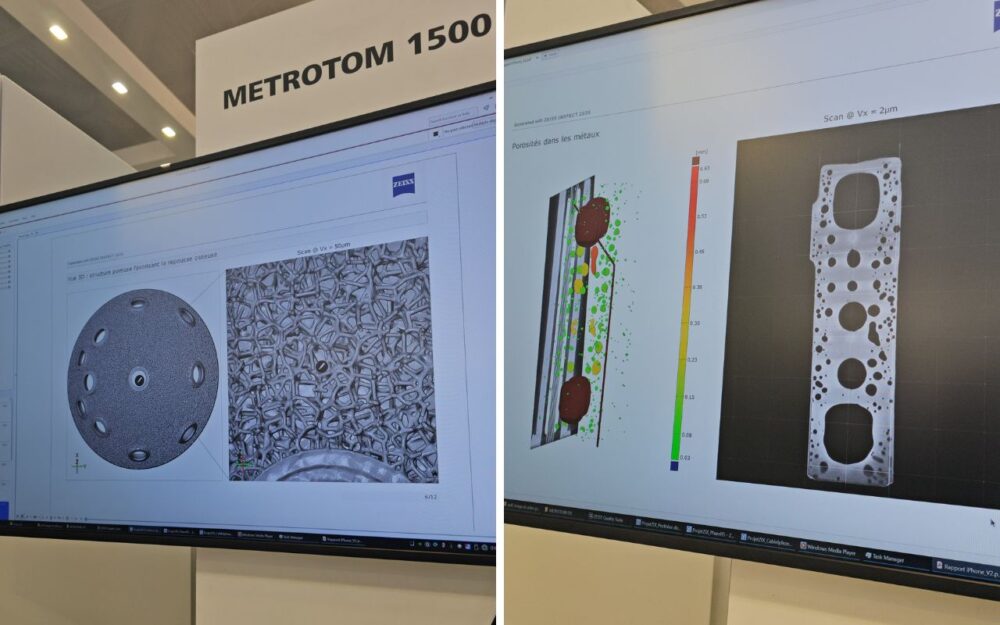
In aerospace, it is used for inspecting critical parts. Regarding the medical field, it is used for porous structures for implants, such as hip prosthesis cups. In foundry, it is used to detect porosities or inclusions. Tomography makes it possible to identify defects that are invisible on the surface and that may affect the mechanical strength of parts.
How Does the METROTOM Work?
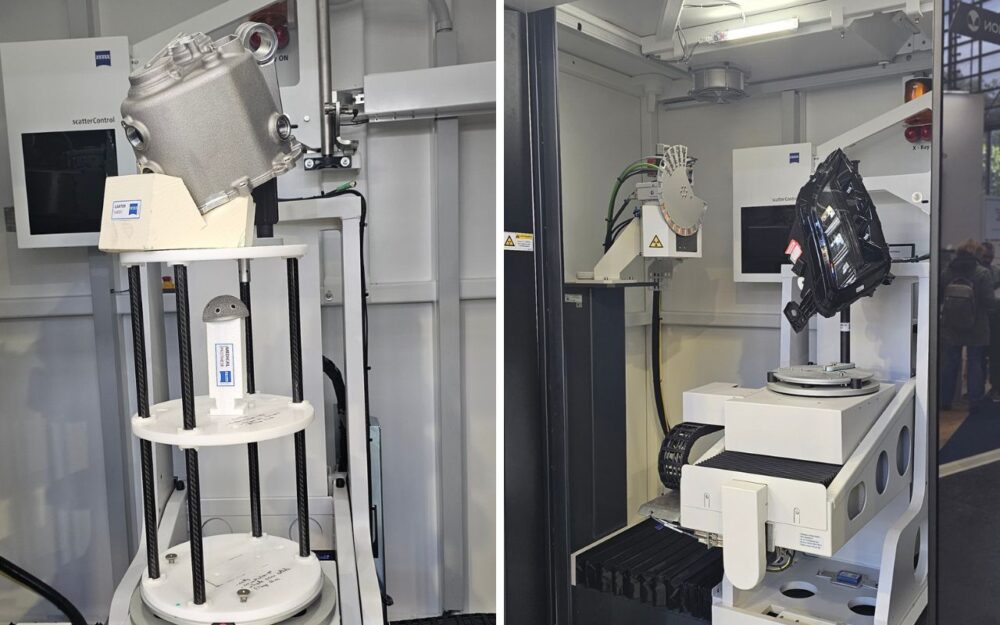
The process relies on acquiring multiple images. The part is first placed on a rotating platform inside the Metrotom, which resembles a large cabinet. A tube, similar to a bulb, emits X-rays that pass through the part. A detector captures the transmitted rays, following a transmission principle similar to a medical radiograph. The platform completes a full rotation, during which between 1,000 and 3,000 radiographs are captured. Software then reconstructs a complete 3D model of the part.
“The scan time varies from a few minutes for a quick inspection up to two hours for high-resolution analysis.”
The result is a full volumetric reconstruction, including all internal surfaces.
Why Present It at Global Industrie?
This is the first time Zeiss has exhibited the METROTOM 1500 in France. The objective is to showcase its versatility and address the diverse needs of French manufacturers, particularly in aerospace and automotive. It is also an opportunity to demonstrate how the sector continues to innovate.
Indeed, while the principle of X-ray tomography remains unchanged (passing radiation through a part and analyzing what comes out), innovation remains very active, both in hardware and software. This is the message Zeiss aimed to convey at the show.
“All tomographs operate more or less on the same principle. The difference lies in reconstruction, software corrections, but also in the physical solutions integrated into the machine.”
How Innovation Continues in Metrology and Tomography
One of the main areas of innovation is reducing noise at the source. On large parts, one of the major challenges is X-ray scattering. In addition to absorption, part of the radiation is dispersed in all directions, creating a kind of fog that degrades image quality.
To address this, the METROTOM 1500 integrates an anti-scatter grid placed between the source and the detector. Its role is to filter out this pollution and improve data readability, which is critical when inspecting large volumes.
“It was important for large parts, because this machine is designed to scan large components, to remove this pollution, which becomes even more significant as parts get bigger.”
Another key area is the trade-off between scan time and data quality. The longer the acquisition, the cleaner the images, but at the expense of productivity. Innovation therefore aims to reduce scan times while maintaining high precision. This is where artificial intelligence comes into play. Models are trained on parts that intentionally include defects, so they can learn to detect them even in noisy data.
“For example, if you perform a one-minute scan, you may have a lot of noise. Despite that, once the model has been trained, you can achieve remarkable reliability in defect detection.”
Contrary to the idea that innovation is purely software-driven, progress is also significant on the hardware side.
“Detectors continue to improve, with less noise, smaller pixels, and a higher number of pixels, which improves resolution for a given object size.”
Material miniaturization and more efficient materials also play a role, particularly with increasingly performant transistors. In addition, there are physical solutions capable of measuring and directly correcting certain artifacts, complementing software processing.
Machines Increasingly Integrated Into Production
Innovation also comes from usage. Tomography is no longer limited to laboratories; it is now deployed directly on production lines, sometimes automated with robots or cobots. This evolution allows better integration into industrial workflows and real-time quality control, as well as the inspection of sensitive or deformable materials.
“Tomography can be used on soft materials. If you want to measure them using contact methods, they deform, which affects measurement reliability. With tomography, since it is a non-contact technique, the part is not deformed, making it particularly relevant for such materials. Many customers working with rubber, for example, have turned to in-line metrology for this reason.”
Pushing the Limits of Materials and Dimensions
The final area of innovation is the ability to process increasingly complex parts. Increasing the voltage of X-ray sources on some models (up to 320 kV) makes it possible to penetrate denser materials such as steel or cast iron, pushing the limits of the maximum thickness that can be analyzed. This is a key issue in sectors like aerospace.
However, some materials with very high atomic numbers, such as gold, lead, or tungsten, which can be found in electronics, remain difficult to analyze in large volumes. This opens the door to new technical challenges.