

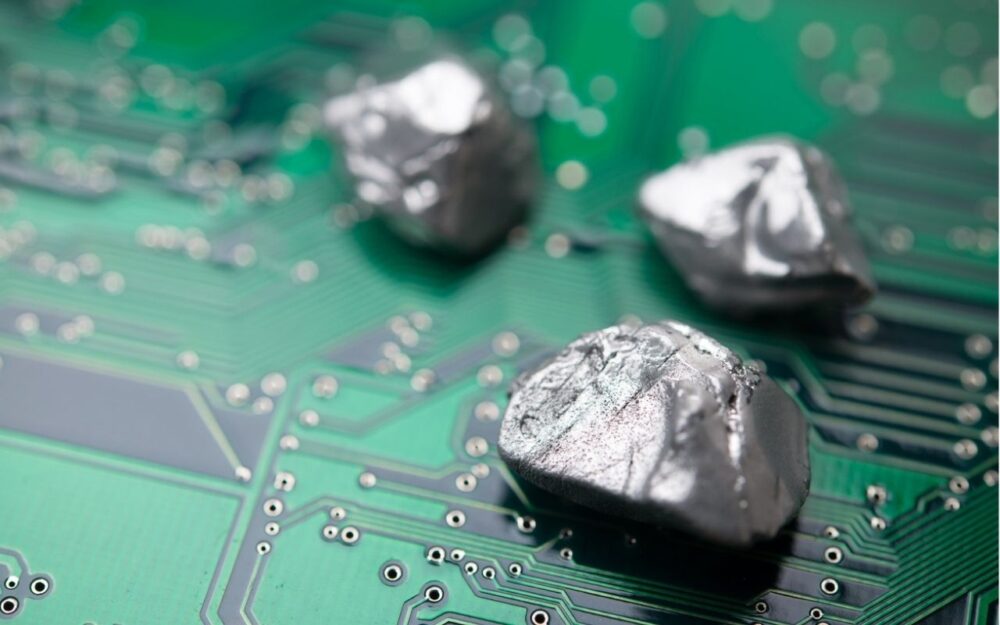

China’s control of the rare earth metals powering Europe’s transition technologies has placed the EU in a precarious position. As it scrambles to reduce its dependence, the odds of success are still unclear.
A Rare Predicament
As Europe accelerates its green and digital transitions, a critical vulnerability sits beneath the surface of its industrial ambitions. Rare earth elements — essential to electric vehicles, wind turbines, smartphones, semiconductors, and defence systems — are overwhelmingly controlled by a single country: China.
While the EU has begun to acknowledge the strategic risks this poses, industry experts warn that Europe remains dangerously exposed, with diversification efforts moving far too slowly.
This predicament is the result of decades of underinvestment, misplaced assumptions, and a failure to match China’s long-term industrial strategy.
Overwhelming Dominance
China’s grip on rare earths is both profound and — as of 2025 — heavily strategic. While it accounts for just over 60% of global mined supply, its dominance becomes overwhelming further down the value chain. More than 90% of rare earth processing and refining — and an even higher share of permanent magnet production — takes place within Chinese borders. Such magnets are essential because they provide a constant, reliable magnetic field without requiring external power, making them critical for energy-efficient electric motors, generators, and modern electronics.
This downstream dominance is where Chinese leverage really lies. Mining rare earths is only the first step; transforming raw material into usable oxides, metals, and magnets is capital-intensive, technically complex, and environmentally challenging. China has spent decades building this capacity at scale.
For Ellie Saklatvala, Head of Metal Pricing at Argus Media, who tracks rare earth markets and supply chains across the world,
“China has outpaced the rest of the world for decades in terms of its investment and commitment to building up a rare earths industry. That includes not just domestic production, but also very close connections with Myanmar’s mining industry just over the border.”
By contrast, Europe and other Western economies have largely opted out of these heavy industrial processes. Processing and refining have been outsourced for many years, while manufacturers benefitted from cheap, reliable access to finished components.
“To an extent, the rest of the world has been happy to sit back and let China take care of a lot of the heavy industrial processes that we then later benefit from via the finished product,” Saklatvala says. “Whether that product is an electric vehicle, a wind turbine, or a smartphone.”
A Vulnerability Long Ignored
Warnings about this dependency are not new. Industry participants have been flagging the risks for years, particularly as rare earths have become increasingly vital to clean energy technologies and defence supply chains. Yet political action has lagged behind.
“Many people in the rare earths industry have been clamouring for years, pointing out this strategic supply chain vulnerability, but Western governments have been slow to act,” Saklatvala notes.
One reason is cost. Developing rare earth projects in Europe or North America is expensive and slow. New mines and processing facilities can require billions in upfront investment and often take a decade or more to reach commercial production. Lengthy permitting processes, environmental concerns, and public opposition add further delays.
But even when projects clear those hurdles, a deeper structural problem remains: pricing power.
“Because of the sheer scale of China’s production and consumption, the Chinese rare earth market effectively sets the price for the rest of the world,” says Saklatvala. “The lack of control that western rare earth producers have over the value of their finished product means they run the risk of investing huge sums of money and time into building up mines and plants, only to find their project economics crushed if rare earth prices suddenly drop in China.”

Read also
Export Controls and a Wake-up Call
Europe’s vulnerability became more visible when China introduced export controls on certain rare earths and magnets in April 2025, requiring licences for overseas buyers. While Beijing later agreed to establish so-called “green channels” for export approvals, this system has offered only limited relief.
“Europeans have managed to access some export licences in recent months, in part owing to these new channels,” says Saklatvala. “But the process is still slow and only certain companies are able to get them.”
In some cases, applications are rejected outright. In others, companies choose not to apply at all, deterred by requirements to disclose highly sensitive business information.
“The overall result is export licences going to a few select end-users for certain purposes,” she explains. “But a lot of other companies are still unable to access material fresh from China.”
These firms are instead forced into the spot market, competing for limited volumes already sitting in international warehouses — often at significantly higher prices. For many European manufacturers, this has become the new normal.
“This could remain the status quo for quite some time,” Saklatvala says.
Read also
Europe’s Policy Response
Brussels has begun to respond. The Critical Raw Materials Act, which entered into force in 2024, sets ambitious targets for domestic extraction, processing, and recycling by 2030, while aiming to limit dependence on any single third country.
This legislation reflects a growing consensus that Europe must rebuild at least part of the rare earths value chain on its own soil, while also diversifying supply through partnerships with countries such as Australia, Canada, and parts of Africa.
Yet turning policy into production is proving difficult. Across Europe, proposed mining and processing projects face permitting bottlenecks, financing gaps, and local opposition. Even where resources exist — in Scandinavia, the Iberian Peninsula, and Eastern Europe — development timelines remain long.
“The EU is moving in the right direction,” Saklatvala says, “but far too slowly. From an industry perspective, there is still a significant gap between ambition and implementation.”
Industry Efforts — and Their Limits
There are signs of momentum. Several European companies are investing in rare earth processing, magnet manufacturing, and recycling. Strategic projects have been identified under EU frameworks, and public funding is starting to flow.
However, Saklatvala argues that government support needs to be more decisive and better aligned with the realities of the sector.
“It would be enormously helpful to see government policy adapt more effectively to the scale of the challenge,” she says. “A more supportive enabling environment would ensure that companies have suitable access to funding measures — from early exploration stages onwards — and that they benefit from efficient permitting procedures.”
Without this, Europe risks repeating past mistakes: strong rhetoric, but insufficient follow-through.
“For many years there has been a lack of alignment between talk and action when it comes to critical minerals policy in Europe,” says Saklatvala. “The industry would warmly welcome a bit more of the latter.”
A Long Road Ahead
The rare earths challenge facing Europe is not one that can be solved quickly. China’s dominance is the product of decades of sustained investment, industrial policy, and market control — advantages that cannot be undone in a single legislative cycle.
In the short to medium term, Europe is likely to remain reliant on Chinese supply, navigating export licences, spot markets, and geopolitical uncertainty. Over the longer term, success will depend on whether policymakers are willing to accept the costs, environmental trade-offs, and financial risks involved in rebuilding parts of the supply chain at home.
What is clear, however, is that rare earths are no longer a niche concern. They sit at the heart of Europe’s energy transition, industrial competitiveness, and strategic autonomy.
As Ellie Saklatvala’s analysis makes plain, the question is no longer whether Europe should act — but whether it can move fast enough to matter.