




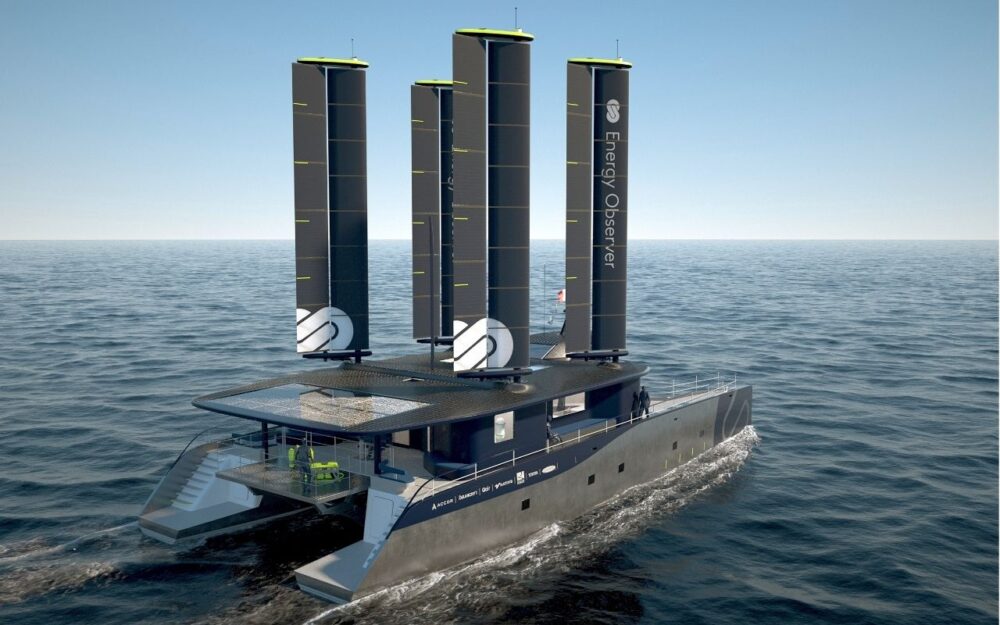

The global shipping industry urgently needs to decarbonize. With the launch of an innovative new vessel, Rockwell Automation and Energy Observer are showing how state-of-the-art technologies could usher in an emissions-free future for maritime transport.
In a hurry? Here are the key notes to know:
- Urgent need for green shipping: Global maritime transport generates around 3% of CO₂ emissions, and with trade volumes expected to triple by 2050, the sector must rapidly adopt clean, scalable solutions.
- EO3 as a zero-emission testbed: Rockwell Automation and Energy Observer are launching EO3, a groundbreaking 30‑meter floating laboratory designed to trial next‑generation clean fuels, propulsion systems, and renewable energy technologies.
- Advanced hybrid energy management: EO3 combines ammonia-based fuel cells, batteries, solar power, automated wing sails, and digital real-time energy orchestration using Rockwell’s automation and data platforms.
- Paving the way to carbon‑neutral seas: Scaling low‑carbon shipping requires fuel infrastructure, cost reductions, and stable global regulations—insights EO3 aims to generate to accelerate credible pathways to net‑zero maritime transport.
The Need for Green Shipping
With around 90% of global trade transported by sea, the maritime sector is a vital backbone in countless supply chains. Yet while it keeps the world’s economy moving, the international shipping industry also leaves a significant environmental footprint, contributing around 3% of global CO2 emissions. In the face of stringent climate goals, there is a pressing need to chart a more sustainable course — particularly with seaborne trade volumes set to triple by 2050.
While the urgency to decarbonize the shipping industry is unmistakable, no clean and commercially viable solution has yet emerged at scale. This means that achieving net-zero shipping emissions will require a revolution in clean fuel technologies, next-generation vessel design, supportive infrastructure, and significant investment.
Read also
EO3: A Cutting-Edge Maritime Laboratory
If game-changing new technologies are needed to power the shipping industry’s green metamorphosis, then Rockwell Automation — the world’s largest industrial automation and digital transformation company — and French start-up Energy Observer are playing a pioneering role in making them a reality.
Continuing a long-term collaboration, the partners recently announced the development of Energy Observer 3 (EO3) — a 30-meter long, 113-tonne, “laboratory vessel” that represents the world’s most ambitious zero-emission watercraft to date.
Unveiled at the United Nations Ocean Conference (UNOC3) in Nice in June, the cutting-edge catamaran will test a variety of low-carbon solutions in real maritime conditions. After it sets sail on a seven-year long global voyage in 2027, it will set new standards for decarbonization, paving the way for a revolution in green maritime mobility.
According to Victorien Erussard, Founder and President of Energy Observer, designed from the outset by Energy Observer as a platform for innovation at sea, EO3’s primary goal is to advance the maritime energy transition:
“This is a next-generation floating laboratory. Its energy system is based on ammonia, a hydrogen carrier that is cracked on board and then used in different technologies —including low-temperature proton exchange membrane (PEM) fuel cells and a high-temperature solid oxide fuel cell (SOFC) — to power silent electric propulsion.”
Read also
High-tech Digital Management
EO3 will explore several complementary pathways for enabling the shipping industry’s paradigm shift towards clean energy — the vessel boasts a combination of fuel cells, batteries, an ammonia internal combustion engine, four automated wing sails, and a superstructure fully covered with high-efficiency solar panels. It also incorporates catalytic systems to limit emissions of nitrogen-based waste products.
Orchestrating this complex hybrid energy system is where Rockwell Automation’s digital solutions come in, coordinating energy flows in real time between different subsystems and monitoring the health of on-board equipment. Open architecture and supervision interfaces will also allow researchers to easily visualizse key data, test new scenarios, and fine-tune settings.
For Gilles Pacaud, Director General of Rockwell Automation France,
“EO3 integrates a range of advanced Rockwell Automation technologies. The use of our Allen-Bradley programmable logic controllers and PowerFlex Drives delivers precise and reliable control of the propulsion and energy systems, while our FactoryTalk Optix — a next-generation visualization and data platform, enables Energy Observer to develop custom applications, aggregate data from multiple systems, boost interoperability, and gain flexibility for innovation.”
Read also our reports on the latest Rockwell’ flagship event Automation Fair
Towards Carbon Neutral Seas
Pioneering projects such as Energy Observer already show that it is technically possible to operate ships with very low emissions, using intelligent energy systems and alternative fuels. But making this the norm across the world’s seas remains a long-term challenge, which depends less on a specific date than the removal of systemic barriers.
“To scale up low-carbon maritime transport, we must build large-scale infrastructure for producing, transporting and bunkering fuels like hydrogen and ammonia,” says Victorien Erussard. “The costs of advanced propulsion and storage technologies also need to fall as they mature and achieve economies of scale. And lastly, we need to see clear, stable international regulations established, with strong price signals and incentives to drive widespread adoption of these innovative solutions.”
Vessels such as EO3 are precisely trying to document these conditions for success:
“It means showing what works at sea, identifying what still holds us back, and sharing these lessons with ship owners, industry, and public decision-makers to help accelerate, in a credible way, the transition towards vessels that are genuinely compatible with carbon neutrality.”
Related articles






![Image [Best of 2025] Power Moves in the Energy World](/wp-content/uploads/sites/3/energy-320x213.jpg)
![Image [Best of 2025] How Generative AI Is Transforming Industry](/wp-content/uploads/sites/3/AI-4-320x213.jpg)