


After decades of hype cycles, experimentation, and industrial validation, additive manufacturing has reached real industrial maturity and proven real-world performance. The focus has shifted from what’s possible to what’s dependable, scalable, and ready for sustained, profitable production. Here, Dana McCallum, Head of Global Enterprise Sales at Carbon, shares her perspective on where the technology is headed in 2026 and beyond, and what it takes to move from promise to real-world impact.

Your career spans more than a decade in additive manufacturing. Looking ahead to 2026 and beyond, where do you see the most meaningful opportunities taking shape?
Dana McCallum: “Since I first entered the additive manufacturing (AM) space, the industry has had to cut through a lot of early noise. It wasn’t the overnight, world-changing moment the hype once suggested – but what’s emerged is a lot more meaningful. AM has moved so far beyond novelty and prototyping, and years of steady progress is now translating into real, scalable production. More importantly, it’s enabling genuinely better products in the real world. Whether that’s enabling high-performance, validated industrial parts, improving comfort and quality of life for wheelchair users with advanced seating pads, or transforming dental care with customized solutions and automated workflows. Applications like this are now are now part of everyday production and a goal at Carbon is for our lives to be improved by a 3D printed product every day. To my mind, that’s when the technology truly ‘arrives’ and we’re finally seeing that become reality.
In sectors like medtech, for example, companies that began working with our technology a decade ago are now receiving regulatory approvals for production applications. These are end-use parts coming straight off our machines – perhaps at lower volumes, but with far greater design freedom, speed, and performance. For me, the next phase of AM is about continuing to scale production responsibly, embedding customization even further into mass mainstream manufacturing, and expanding real-world impact. That shift is definitely already well underway.”
What do you see as the biggest challenges still holding the industry back from reaching its full potential at scale – and how is Carbon working through those?
Dana McCallum: “Still one of the biggest challenges for AM, in my view, is perception. In practice, the industry is already operating at scale; at Carbon, we process more than a million 3D-printed parts every single week. However, particularly for those who’ve spent decades in a mature industry like traditional manufacturing, AM can often still be associated with prototyping or one-off parts, rather than seen as a true production technology.
What takes time is showing that AM can do things that are genuinely different and scalable. You can take a design that might seem crazy and tune the technology to produce hundreds of thousands of these parts in a way that’s reliable and economically competitive.
That perception gap becomes even more pronounced when you’re working in regulated or safety-critical environments, where the bar for trust is extremely high. Ultimately, the industry moves past this by proving more than just better design – it has to demonstrate manufacturing robustness at scale, with consistent quality, validated processes, and a reliable material supply chain.”
AI and automation are increasingly becoming an unavoidable part of the manufacturing discussion. How do you see them changing additive workflows, and where do you expect the biggest impact?
Dana McCallum: “AI and automation are already a meaningful part of how AM is evolving, and at Carbon we’ve been using it in very practical ways for some time. In dental, for example, our Automatic Operation Suite automates a lot of the repetitive tasks that slow teams down and gives technicians time back to divert elsewhere, which is a real productivity game changer.
More broadly, I think the next wave of change will come earlier in the workflow, particularly around design. We’re already utilizing AI within our Design Engine latticing software to help customers explore different lattice architectures and better predict how those structures will respond mechanically in the real world. This is really exciting and is just the beginning of how AI could be applied across the broader design workflow.
Expertise in designing specifically for AM, to really leverage its fullest capabilities, has been a bottleneck for a long while, and there’s scope for AI to help change that by embedding manufacturing intelligence directly into design tools. There’s a big difference between a 3D model on screen and one that is actually printable and can stand up in terms of superior performance, and if AI can help guide people to that point then it’s a huge positive for industry advancement. Obviously there are other areas where it’s gaining traction, like emerging work around materials and polymer development, but design is an area where I think AI integration is accelerating fastest and where the impact on the industry will be felt most immediately.”
As AM moves deeper into production, how are customer requirements evolving, and what new expectations are being placed on AM tech providers?
Dana McCallum: “As AM has matured, the conversation with customers has certainly shifted. Reliability has become a key expectation, and a differentiator. Customers aren’t just evaluating whether a technology works; they’re looking for confidence that it will perform the same way every time, at scale, and in real production environments. That level of reliability is what allows AM to move beyond an interesting capability and become a trusted, integral part of how products are designed and made.
Importantly, customers don’t just want access to a machine; they want partners who understand what they’re ultimately trying to make, share that focus on the end product, and can help translate design intent into end performance. That’s why we don’t think about AM as the end goal in itself – it’s the enabler.”
Cost has long been one of the primary barriers to the adoption of AM. How are customers’ views on cost and economic viability evolving?
Dana McCallum: “Of course, cost is always a part of the conversation, especially given the market volatility we’ve seen in recent years. Customers are understandably cautious, and it’s an education component we need to address, because people often assume AM is inherently more expensive. In reality, when you let the application drive how the technology is tuned, you can reach really competitive economics.
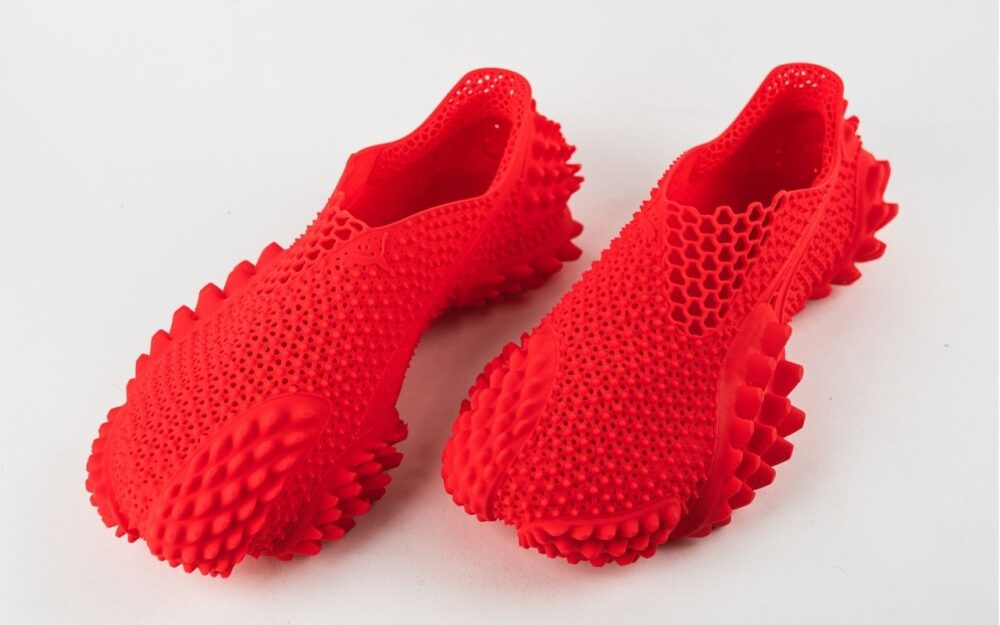
This is why working closely with customers becomes so important. Through these deep partnerships, we can better align the technology with what they actually need, so together we can lower costs, make production applications viable, and support them in scaling successfully. We’ve seen the impact of that approach over time in areas like footwear and protective equipment. You can now see Carbon 3D printed shoes and midsoles on both high-end catwalks and the high-street alike, thanks to years of production experience and long-term partnerships with the likes of Adidas and, more recently, Alexander Wang. Similarly, in sports helmets, with partners like Riddell, we’ve seen advanced, 3D printed designs move beyond professional leagues and into college programs, and now high schools.”
Carbon has built strong momentum in performance-driven consumer applications. How do you see that focus evolving, and which industries or product categories represent the most important growth opportunities ahead?
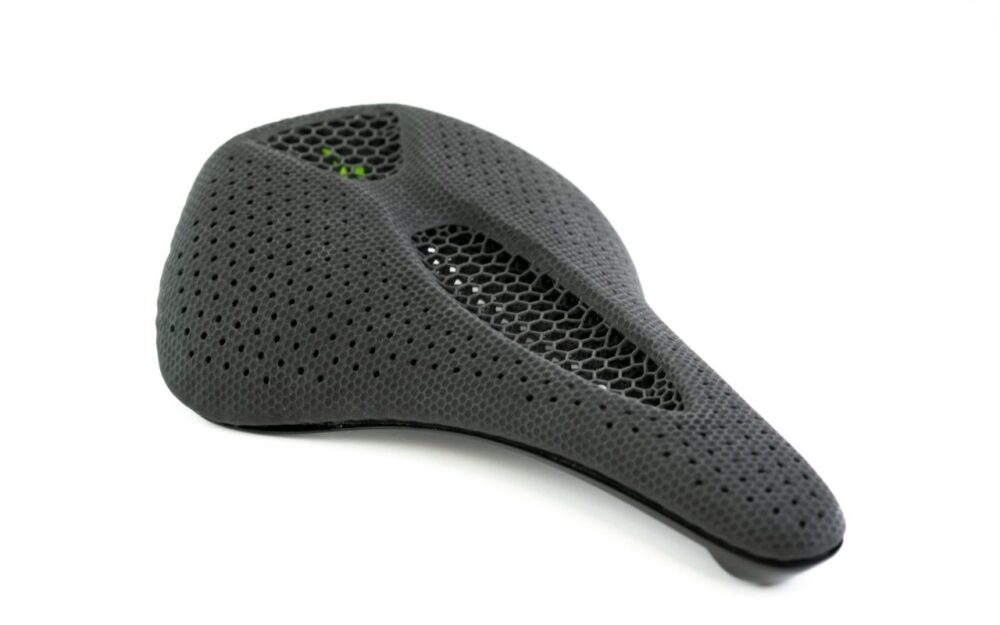
Dana McCallum: “Performance-driven consumer applications like footwear and cycle saddles have always been a strong foundation for us and we continue to see meaningful expansion within those categories – larger volumes, broader adoption, and new customers. For perspective, the 3D printed footwear market alone is valued at over USD 1.6 billion, and projected to reach USD 5.38 billion by 2030*, so the growth opportunity here is still huge.
At the same time, we’re focused on where the next phase of opportunity comes from, where the industry is looking next, and where our technology can make a difference. We have proven that our elastomers can scale in real production environments, and the rigid space now represents a large opportunity. That’s an area in which we’re investing and letting applications help guide how the technology evolves.
More broadly, we’re starting to see momentum build in spaces like medtech, automotive, and apparel, where performance, customization, and digital manufacturing really matter. In automotive, in particular, there are a multitude of functional applications where AM can bring real value, from interior components to more technical parts.”
What are Carbon’s key focus areas and milestones, and how do they reflect your longer-term strategy?
Dana McCallum: “Heading into 2026, we’re staying true to how Carbon has always approached growth: as an innovation-led, product-driven company. Our focus is developing new technology to solve real problems in real markets, which keeps us closely aligned with customer needs rather than chasing technology for its own sake, and has served us really well over the past decade.
We’re also going into 2026 on the back of a strong year, from securing $60 million in funding to announcing major partnerships and seeing our technology deployed across everything from industrial machinery to Tour de France-winning cycles. That breadth gives us a strong foundation for what comes next.”
Finally, stepping back to the broader industry, what shifts or market trends do you expect will define additive manufacturing in 2026?
Dana McCallum: “I think this year will be less about the bold and exciting promises of what’s possible with AM and more about steady proof of what’s scalable, profitable, dependable and actually worth integrating into everyday manufacturing. One of the most meaningful developments will always be AM continuing to earn its place in the mainstream.
I would also expect continued consolidation. AM is fundamentally challenging – it’s capital-intensive, and hardware and materials each bring their own complexities, even aside from the broader operational picture. So looking at the market longer-term, the players that remain will naturally be larger, more mature, and oriented around sustainable value creation rather than short-term wins. At the same time, the model for growth is changing. Success will come from working deeply with brands and OEMs to solve real problems and bring differentiated products to market. Printer deployments alone won’t define success; utilization will. Revenue will follow application success, not the other way around.
Overall, 2026 feels like a point where the industry’s years of groundwork begin to show up more clearly in scaled production, real utilization, and sustained impact – and that’s a very healthy and encouraging place for the industry to be.”
Related article